Karl Patrick R. Mendoza

Communication scholar of trust, culture, institutions, and public life.

Distrust is not apathy. It is judgement


Filipinos who say they trust no politician keep voting, marching and arguing with power. Two concepts from Philippine research explain why that is not a contradiction.


October 23, 2026

[Picture]
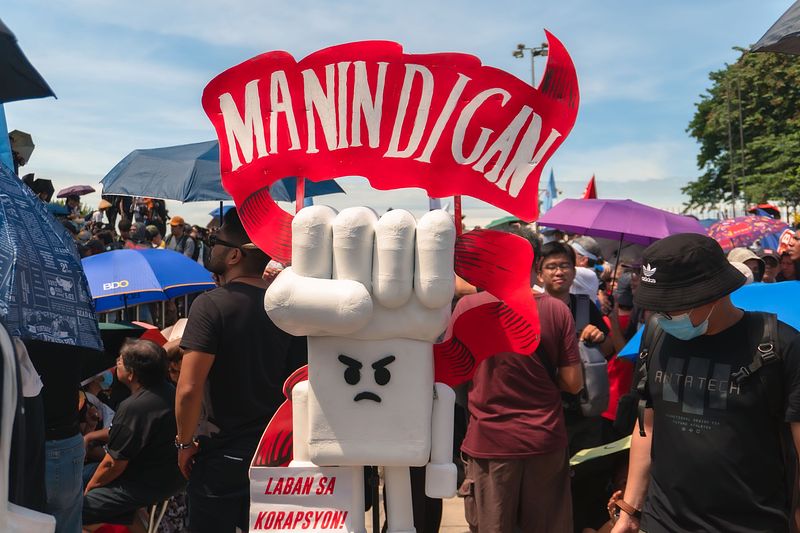
"Take a stand": an anti-corruption rally in Rizal Park, Manila. Photo: Kahn Ilagan via Pexels.

A conversation over coffee

My father works overseas and is rarely home. Last year his visit fell in the weeks when the Senate and the House were holding hearings on the flood-control scandal. One Saturday afternoon, over coffee, talk turned to the engineers and officials of our hometown.
My mother made a distinction I had heard all my life without hearing it. An official, she said, can be mabait (good, kind) without being matino (upright). My father added that this may be why so many voters choose the mabait over the matino. We were half joking, half resigned.

I have been working out what we meant since. Perhaps hiya (shame), tino (uprightness) and bait (goodness) are the grammar through which many Filipinos decide how much of their trust a politician has used up, and how much he still holds. I developed it in a research note for Social Transformations. This essay takes it further.

The year of the straw hat

I am writing from Bangkok, where I have been a visiting fellow since June. From here, the Philippines looks less like an exception than one instance of a regional pattern.

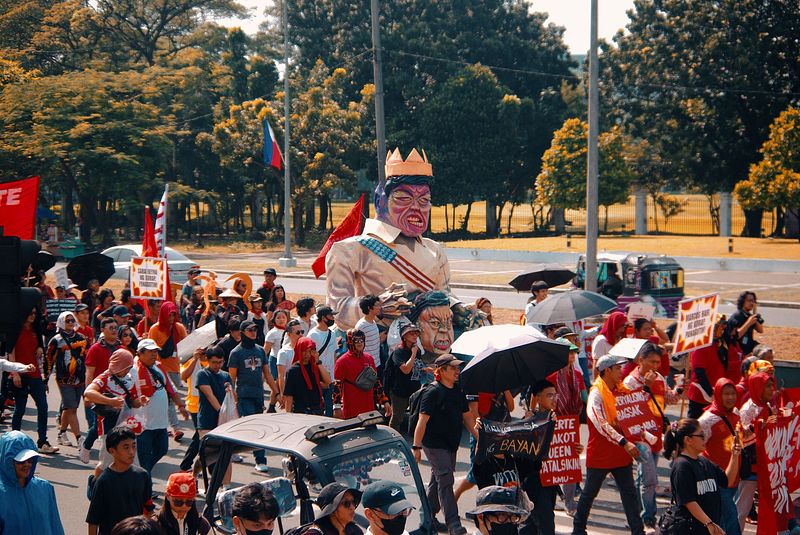
In late August 2025, Indonesian protesters filled the streets against a self-serving political class. In September, Nepal's prime minister resigned after youth-led protests turned deadly. On 21 September, tens of thousands of Filipinos rallied at Luneta and on EDSA against the same flood-control corruption my family had argued about.
[Picture]
Apathy, as observed in Manila. Protesters parade an effigy crowned "king of the corrupt". Photo: Mico Medel via Pexels.
In all three countries, some young protesters carried the same emblem: the straw-hat pirate flag from the anime One Piece. Thai protesters had already borrowed the three-finger salute from The Hunger Games after the 2014 coup. 

None of these crowds trusted the people who govern them. None of them had given up on politics either. That is the puzzle this essay takes up. 

A vocabulary built elsewhere

I learned the vocabulary of trust research in Christchurch, New Zealand, where I wrote my doctoral thesis on trust, journalism and the Philippines' Dengvaxia vaccine controversy. Much of it comes from the North Atlantic, where high institutional confidence was long treated as normal.
 
On that view, trust works like a thermometer. When the reading falls, people are assumed to be withdrawing, and democracy weakening.
 
Then I encountered the Polish sociologist Piotr Sztompka. Writing after the fall of communism, Sztompka argued that every society carries a "culture of trust": inherited rules about whom one may sensibly rely on, in which matters, and with what safeguards. In his Poland, people trusted family and neighbours and suspected public institutions. That sounded like home.
 
What I took from Sztompka is that distrust is historically produced and patterned, not a flaw in national character. I first borrowed his term as it stood, for an early study of Dengvaxia news coverage. What I later changed was the scale. Where he wrote of a society's culture of trust in the singular, the Philippine cases I studied showed several at work at once. In that controversy, parents, doctors and journalists judged the same vaccine by different standards, and the scandal turned on which standards won.
 

What the thermometer cannot read

The Philippines kept refusing to fit the thermometer. In May 2025, 81.65 percent of registered voters turned out for the midterm elections, the highest midterm turnout the Commission on Elections had recorded. Many of those voters would readily tell a pollster how little they trust politicians.

Two readings circulate at home. The first is contempt. Educated Filipinos still reach for the word bobotante, a blend of bobo (stupid) and botante (voter), to blame bad officials on the people who elect them. As Randy David argued in August, the label mistakes a coherent view of how the state works for ignorance.

The second reading treats trust ratings as a scoreboard. The quarterly "trust ratings" of the president and vice president are reported as a running tally of mood and alignment. When Pulse Asia found in March 2025 that President Marcos's trust rating had fallen from 42 to 25 percent in a month, while Vice President Sara Duterte's rose from 53 to 61 percent, the shift was read as a verdict on Rodrigo Duterte's arrest and transfer to The Hague.
 
That is a fair reading of a horse race. It says almost nothing about how people relate to the authorities they distrust.
 

Standing on others' shoulders

 The claim that distrust need not mean disengagement is not new. Pippa Norris's Critical Citizens showed in 1999 that many citizens in established democracies combine strong support for democracy with low confidence in its institutions. Pierre Rosanvallon argued that citizens organize distrust into a "counter-democracy" of vigilance, denunciation and judgement.

Closer to home, Adele Webb traced the Philippines' long journey to democratic ambivalence. On New Mandala, Nicole Curato showed survivors of Typhoon Haiyan practising democracy through protest and mutual aid, and Roanne van Voorst found residents of a Jakarta slum who distrusted politicians yet placed their hopes in a candidate because he had come and listened.
 
What I want to add is narrower. It concerns where the standards of judgement come from, and how the judging is done.
 

Shared ways of judging

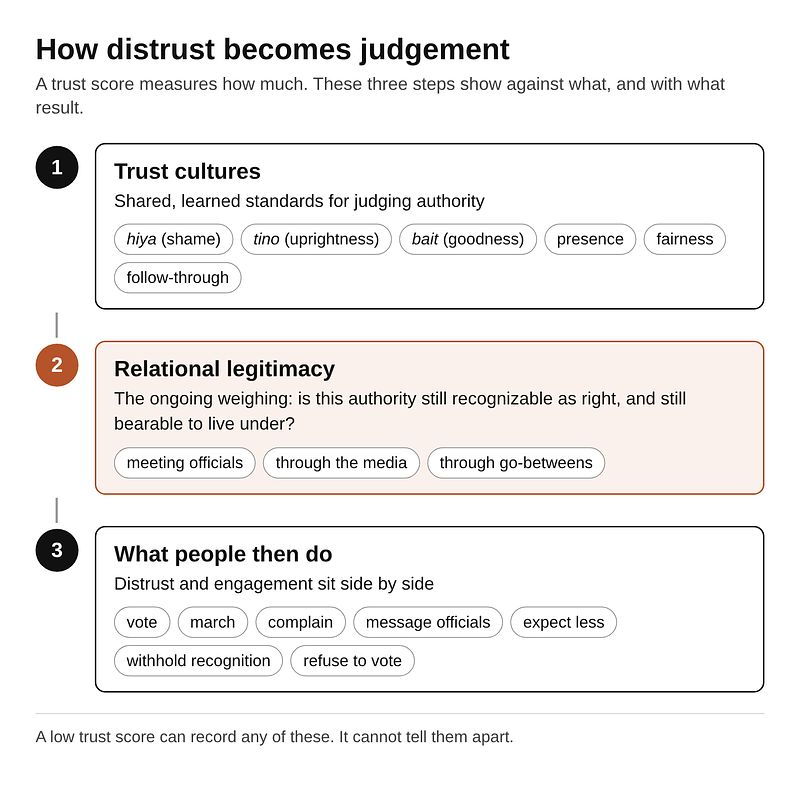
 The first concept is trust cultures, which I define as "meso-level repertoires through which patterned expectations about authority become socially organized" (Philippine Sociological Review). In plainer terms, people do not decide whether to trust an official from scratch. They draw on shared, learned ways of judging authority: what a decent leader owes, what counts as a betrayal, what can be forgiven.

They sit between the individual and the nation, in communities, publics and institutions rather than "Filipino culture" as a whole.

Consider the tsinelas, the rubber slipper. Jesse Robredo, long-serving mayor of Naga, was known for turning up in slippers and wading through flooded streets, ready to get his feet wet. "Tsinelas leadership" became a standard of accessibility that other officials are still measured against.

Its opposite is the official judged walang hiya (without shame). This is where my mother's distinction does its work. A survey item on "confidence in local government" can tell us that an official is distrusted. It cannot tell us whether he has been judged hindi matino, a verdict on his competence and reliability, or walang hiya, which is far heavier, or whether he is still mabait in spite of both. Many Filipinos hold all three judgements about the same person at once.
 
Trust cultures are not generalized trust, and they are not national character. Nor are they legitimacy itself. They supply the resources people use to judge it.
 

Weighing whether authority is still bearable

The second concept is relational legitimacy, which I define as "the evaluative process through which publics negotiate whether authority remains morally recognizable and socially bearable under concrete conditions of uncertainty." Legitimacy, on this view, is not a fixed stock that a government has or lacks. It is weighed continually, and the weighing happens in relationships: in encounters with officials, through the media, and through the people who stand between citizens and the state.
 
[Picture]
How distrust becomes judgement.
With colleagues, I interviewed sixteen residents of Barangay Pinagbuhatan in Pasig City, governed since 2019 by Mayor Vico Sotto's reformist administration. Residents judged reform by more than its programmes. They asked whether leaders were nakikita (seen) and napupuntahan (reachable). They counted a fast reply from a government page online as a kind of presence: "kahit hindi mo sila makita, sumasagot naman" (even if you don't see them, they respond).

They praised services that were walang palakasan (without favouritism) and help that "hindi na kailangan ng backer" (no longer needs a backer). Several insisted that public assistance created no utang na loob (debt of gratitude): it was a karapatan (right), not a favour.

Many who praised city hall described their barangay differently, where "pag may kakilala… madaling makapasok" (if you know someone, it is easy to get in). They did not settle the matter by deciding whether government in general could be trusted. As we put it in the article, trust was "recalibrated rather than revoked." 

Relational legitimacy, then, is neither trust nor compliance. People can keep using services while withdrawing recognition. They can distrust a whole class of politicians while still treating an election, or a march down EDSA, as the place where their judgement counts. In Pasig, residents were neither believers nor drop-outs. They were evaluators. 

Reading distrust differently

If this account holds, three things follow.
 
First, a low trust score is not, by itself, a verdict of exit. It may record a public that is judging hard. A mayor in slippers and a senator in a convoy may score the same on a five-point scale yet be judged in different terms.
 
Second, reform does not legitimate itself. Pasig residents rewarded coherence: a reachable mayor, services that did not depend on connections, promises that became roads and clinics. Where these came apart, support became conditional rather than collapsing.
 
Third, the language of apathy deserves retirement. A generation that borrows a pirate flag from a Japanese comic and a salute from a Hollywood dystopia to confront its rulers is not apathetic. It is improvising a shared moral code for judging authority it no longer takes on trust. So is the voter who queues for hours to choose among politicians she does not trust.
 

Where the argument stops

Engagement born of distrust is not always democratic, nor does it always point toward reform. The same vocabulary that lets Pasig residents demand services as rights can bind supporters to a leader as a debt. John Lee Candelaria argued on New Mandala that utang na loob helps explain why support for Rodrigo Duterte grew after his arrest.

My parents' distinction cuts both ways too. If bait survives when hiya and tino are gone, a leader can be condemned as shameless and irresponsible and still be re-elected for being kind. Trust cultures help explain both outcomes. They do not guarantee the better one.

Nor does distrust always take the form of showing up. In Indonesia, the golput tradition of deliberately not voting turns abstention itself into a statement. Even in Pasig, some residents said of their barangay "minsan parang hindi mo alam kung sino lalapitan" (sometimes you don't know who to approach). Where people cannot find anyone to judge, judgement can turn into resignation.
 
The claim here is modest. Distrust does not necessarily mean disengagement, and disengagement, where it appears, needs explaining rather than assuming.
 

A view from the Philippines

 From the North Atlantic, the Philippine story usually reads as weak institutions and disillusioned voters. From a family argument about the hometown engineer, it reads differently. Publics here have long lived with institutions that fall short, and have learned to judge, bargain with and hold on to authority without surrendering to it or abandoning it.
 
As distrust becomes the ordinary condition in many older democracies too, the Philippine pattern may turn out to be less an anomaly than an early view of how democratic attachment works when confidence can no longer be assumed. Readers in Thailand, Indonesia or Malaysia are better placed than I am to test that claim.
 
What the Philippine case already makes clear is that distrust is not the end of a political relationship. Often it is the form that relationship takes.
 
Karl Patrick R. Mendoza, PhD, is a Filipino communication scholar and the inaugural Surin Pitsuwan Visiting Fellow at the Faculty of Political Science, Thammasat University. He develops this argument in Trust Cultures and the Politics of Relational Legitimacy: Rethinking Trust from the Global South (Routledge, 12 November 2026) and will discuss it in a public lecture there on 13 November.


AI-use note: I wrote this essay with Claude (Anthropic; Claude Fable 5.1 and Claude Opus 5.5). Claude helped draft and edit the text, check sources and links, and choose the photographs. The argument, the concepts, the research behind them, the family conversation and the final wording are mine, and I take responsibility for every claim.